
The Paywall Predicament

The Paywall Predicament
The other day, a social media post about paywalls caught my attention. “Everytime I hit a paywall on some respected journalism site and then simply don't read the article rather than subscribing, I think about how Fox, Breitbart, The Daily Mail, et al. never ever ever paywall their content,” the poster wrote. “I think about this constantly.”Not long after, Justin King, the journalist YouTuber better known as Beau of the Fifth Column, discussed why he doesn't put his content behind a paywall. A viewer wrote about being unable to figure out what, exactly, had happened to Paul Pelosi, since so many of the sites reporting about the incident required a subscription to continue reading, but he could only find “absolute bull” about the attack being reported on sites like Fox and InfoWars.America, we have a problem!Good quality, trustworthy journalism has a cost. It's produced by people who do honest research, and who also like to eat a couple meals a day and keep a roof over their heads at the same time. There are multiple ways to accomplish this, and the subscription model is the most direct. You pay for content, and content is what you get.Of course, not everyone prioritizes or can afford to pay for subscriptions to a wide variety of news sites, or perhaps any at all. Enter the ad-based sites, in which content appears to be free, because it is served up with a heaping helping of ads (above, below, alongside, popped up, popped under, and sometimes even blocking the content altogether). Unfortunately, these outlets at least a little beholden to the agenda of ad buyers. (Just ask Elon Musk how sponsors disappear when content moderation ceases being brand safe, for example.) In addition, this revenue model inverts who, exactly, is the customer, and what the product is.If you're looking at ad-supported content, your eyeballs (and headspace) are the product. Your attention is being sold to the ad buyers, who are the real paying customers. The content you're reading is just the bait, used to draw you in. And because the website prospers through delivering as many ad impressions as possible, that bait doesn't necessarily have to be factual. In fact, it may be better if it's not, since strong emotion is what makes content go viral most reliably. Outrage, anxiety, and anger are just as valuable as awe, joy, or surprise, in this context. The more a piece is shared, the better.That the ad-based revenue model is problematic has been known for years, but simple ad impressions aren't worth very much per each. The real money is in targeted ads that take advantage of your personal data to direct your attention toward things you may actually buy are much more lucrative. This is the premise behind social media, a honeypot of freely given personal data that makes targeting you much easier. By 2016, the Cambridge Analytica scandal showed just how far the data-driven model could be taken.In the recent midterm elections, however, the chickens of outrage have come home to roost. Constant repetition of the Big Lie – that the 2020 presidential election was stolen – generated the kind of outrage that underwrites worthwhile ad revenue, especially for sites that don't hide behind a paywall. It can really motivate voter turnout, too, at least at first. In an interview with Alex Jones of InfoWars, however, Republican political consultant (and Nixon fanboy) Roger Stone opined that pushing the Big Lie so hard may have been behind the lack of a discernable “red wave” in the midterms. Tell people often enough that elections are rigged, and they're not going to believe their vote counts anymore, so why bother? “Their attitude is that it's broken and it cannot be fixed,” said Stone, “so I'm gonna go to my kid's Little League Game [instead of voting].”
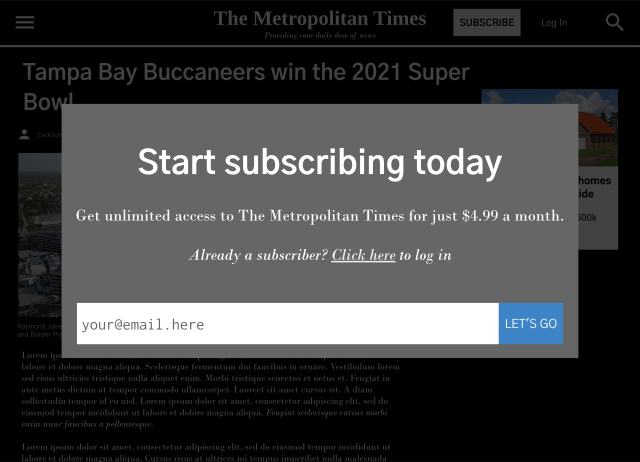 An example paywall from a fictional news source. Image created by and courtesy of Baron Maddock, as found on Wikimedia Commons. CC BY 4.0
Sources:
Ron Filipkowski on Twitter
Let's talk about paywalls and democracy....
The Internet's Original Sin
The Secret to Online Success: What Makes Content Go Viral
What Makes Positive Content Go Viral?
GOP Congressman Dan Crenshaw says election deniers know they’re lying
What Does Twitter Mean for Brands Under Elon Musk’s Rule?
Paywalls, Newsletters, and the New Echo Chamber
A Propaganda Model

About Dawn Allen
Dawn Allen is a freelance writer and editor who is passionate about sustainability, political economy, gardening, traditional craftwork, and simple living. She and her husband are currently renovating a rural homestead in southeastern Michigan.