
Supreme Court Considers Whether Encouraging Illegal Immigration is a First Amendment Right
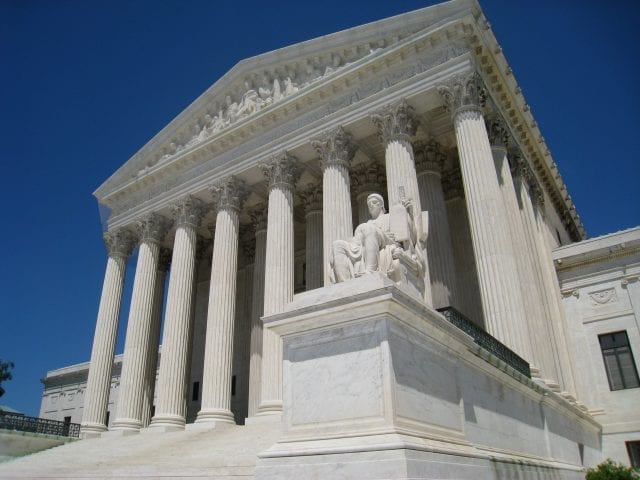
Supreme Court Considers Whether Encouraging Illegal Immigration is a First Amendment Right
The Supreme Court will consider whether encouraging illegal immigration is a protected form of free speech.According to The New York Times, the case centers on a 1986 statute that criminalizes doing just that. In a ruling made last year, a circuit court judge struck down the rule unequivocally.“The statute potentially criminalizes the simple words—spoken to a son, a wife, a parent, a friend, a neighbor, a co-worker, a student, a client – ‘I encourage you to stay here,’” Judge A. Wallace Tashima wrote in a unanimous decision for a panel of the U.S. Court of Appeals for the Ninth Circuit in San Francisco.The case, notes the New York Times, is called United States v. Sineneng-Smith. It’s considered of the most significant immigration cases on the court’s docket, along with a reconsideration of President Trump’s decision to rescind the Deferred Action for Childhood Arrivals program.The Supreme Court will also consider whether immigrants can challenge expedited removal orders in court.However, Sineneng-Smith is different, in that it’s often characterized as an explicitly constitutional issue. First Amendment protections are one of a rare few issues that liberal and conservative justices tend to see eye-to-eye on.As the N.Y.T. reports, the case is named after Evelyn Sineneng-Smith, an immigration attorney based out of San Jose, California. Sineneng-Smith made national headlines when an investigation found her charging undocumented immigrants—many from the Philippines—thousands of dollars to file applications for residency programs which had already been avoided by the federal government.Sineneng-Smith knew the programs were no longer active, but charged her clients up to $6,800 each to prepare and submit paperwork.She was later convicted of mail fraud and charged under the 1986 law for illegally encouraging her clients to stay in the United States. While Sineneng-Smith isn’t challenging the mail fraud conviction, she maintains she had a First Amendment right to file the applications.
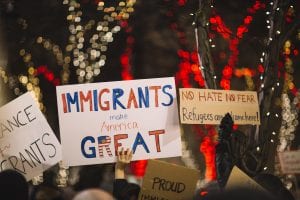 Sign saying "Immigrants make America Great" and one saying "No Hate, No Fear, Refugees are Welcome here;" image by Nitish Meena, via Unsplash.com.
Sources
Is It a Crime to Encourage Unauthorized Immigration? The Supreme Court Will DecideThe Supreme Court May Criminalize Immigrant Advocacy
About Ryan J. Farrick
Ryan Farrick is a freelance writer and small business advertising consultant based out of mid-Michigan. Passionate about international politics and world affairs, he’s an avid traveler with a keen interest in the connections between South Asia and the United States. Ryan studied neuroscience and has spent the last several years working as an operations manager in transportation logistics.