
Legal Problems Involved in Gig Economy
Legal Problems Involved in Gig Economy
The gig economy seems to be taking over the world. This relatively new employment mode is backed by technological advancements, and it looks like it is here to stay. The idea of a temporary job opportunity is appealing to both companies and gig workers. While companies benefit from temporary employees and prompt workforce scaling, gig workers are drawn to flextime and an opportunity to compile a diverse portfolio of clients.According to gig economy statistics, more than 50% of US employees are likely to participate in the gig economy by 2027. Interestingly, 76% of workers who have already been partaking in the economy claim that they are happy with their choice. While the gig economy has already taken over multiple industries, starting from the education, manufacture, and legal sector, numerous issues are to be addressed before the gig economy expands further.Multiple Clients: A Double-Edged Sword While a diverse client portfolio speaks volumes about one’s expertise, it can be a primary cause of a severe headache. Many gig workers jump from one client to another, looking for a specific connection and a somewhat steady job opportunity. Once they get their hands on one, they might face taxation problems.Perhaps, most issues arise when one gets to do taxes single-handedly. In most cases, gig workers tend to spend most of their time building up their client base, which translates into diverting attention from doing taxes. Thus, many workers end up forgetting about taxation to the point of no return. In other words, if a gig workerhas over $400 net self-employment earnings and they do not file their taxes every quarter, they might be subject to a penalty at the end of the year. The best piece of advice here is to find a professional accountant who knows the inner workings of gig employment. That is the most straightforward way to ensure that you are on the safe side.Unclear Employment StatusGetting a gig is great, but upon closer inspection, one could discover that there is no clear employment status. Gig workers operate in a gray area, meaning they often do not get a standard set of benefits. Instead, they have to deal with arising health and social security concerns on their own. This type of employment status also affects how a gig worker has to file their taxes. Aside from potential taxation problems, employers may often breach a contract and harm employees because of it.A breach of contract may happen at any gig, and it’s usually a sign that an employer is not transparent. What’s more, employers do know that gig workers will have numerous problems with seeking legal guidance. Beware since clients often alter agreements or put an end to a contract before its due date. That’s why gig workers are advised to hire a lawyer who will oversee contracts with one’s clients. By doing this, you will ensure that you are not getting the short end of the stick, and should anything go south (should you experience a breach of contract), you will get compensated.Payment ProblemsNearly 74% of gig workers would leave the marketplace because of payment problems. As many as 29% of respondents reported instances of not receiving payment, and 27% claimed their payments were late. Some gig workers decide to register as business owners. It’s easier to claim payments as a business, and taxation rules are more straightforward. That said, they tend to forget to protect themselves legally, which leads to payment issues. Sometimes a client goes as far as denying a payment, and gig workers are then left with empty pockets and not a single chance of fighting back in proper legal settings.If a gig worker is hired online, via a platform, in most cases, they are protected by a corresponding escrow. A third-party platform can help workers manage cooperation with multiple clients for a certain fee. If a gig worker decides to leave a platform, they might save up on fees but get in hot water with some international clients since missed payments or lack of payment methods might become an insurmountable obstacle.PayPal is possibly the best way to charge clients, both locally and globally. Gig workers who deal with offline jobs can also sign a contract that guarantees a certain percentage of upfront payment.Less Than a Minimum WageThe market is vast, and competition is ever-increasing, making some gig workers drop their prices to appease more potential employers. Eventually, if enough gig workers are willing to get paid less, the whole market suffers. Many end up working for less than an hourly minimum wage, which inevitably affects other areas of their life.In early 2019, the US Congress and 16 states introduced legislation that requires that all workers get paid full miniumum wage plus tips. It’s yet to be seen how this legislation will affect the gig economy, and if it will succeed in enforcing all companies to follow through.Click on the graphic below for more interesting facts and statistics.
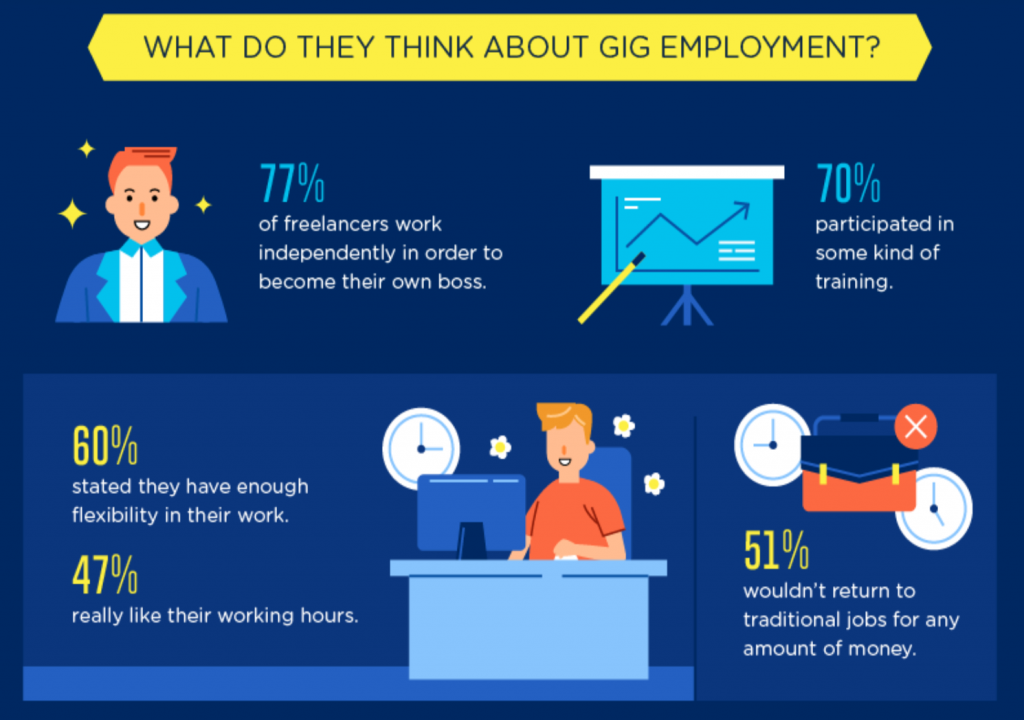 Graphic: What Do They Think About Gig Employment? Courtesy of author.

About Karthik Reddy
Karthik Reddy, Community Manager at bettingsites, is the author of India’s Number 1 travel blog. Having an MBA in computer science, he once decided to get away from the office desk life and take the breathtaking journey of traveling the world. He is eager to use the sociability of the web to inspire others. A passionate traveler and photography enthusiast he aspires to share his experiences and help people see the world through his lens.