
Ghost Acres

Ghost Acres
You've probably heard it said that if everyone lived as Americans do, it would take five Earths to satisfy that level of resource use. Most other nations have a smaller number of “Earth” units; if everyone lived as they do in India, for example, we could all get by on 0.7 “Earths,” a reasonably sustainable number. Overall, though, we humans are tearing through the planet's ecosystems 1.75 times faster than they can regenerate themselves naturally. Since we're only living on one Earth, how is such a figure even possible? This is where ghost acres fill in the gap.For most of the time we've existed as a species, people met their needs locally. They gathered or grew plants, hunted or herded, and crafted items from materials obtained not too far from where they lived and died, and they disposed of their waste products the same way. Not every region had the same carrying capacity. More people lived where resources abounded. Fewer people lived where there wasn't enough to support them. Trade routes to distant lands existed, but people traded mostly for luxury items, not everyday needs.Eventually, local resources weren't enough. Small, crowded polities needed more food than they could grow in order to feed everyone. Importing from somewhere else was the obvious next step. Colonial England wasn't the first to rely on imports from ghost acres – faraway, unseen lands – to support their population, but they kicked it into overdrive. First, they imported food and raw materials from colonies across the world, eventually using North America, Africa, Asia, and the Pacific as their ghost acres separated from the mother country by great distances. Then, they pioneered the industrial exploitation of ghost acres separated in time, by mining and burning coal to release solar energy deposits from hundreds of millions of years ago.
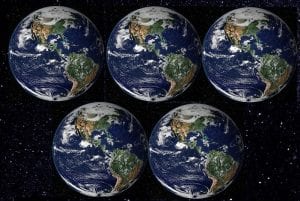 It would take "five earths" to satisfy a global population at the level of consumption that the United States currently enjoys. That's a lot of ghost acres! Combined image by the author, comprised of public domain images. Earth photo created by NASA, courtesy of Wikimedia Commons. Background image by Dorothe, courtesy of pxhere.com.
Sources:
Some U.S. Farm Fields May Never Be Harvested Again
Chile Faces Mine Stoppages as Workers Join Protests
Floating cities: The new future for climate refugees?
Cocoa’s child laborers
Hazardous Travels: A Ship's Tale of U.S. Ghost Acres and the Global Waste Economy
London’s Soap Industry and the Development of Global Ghost Acres in the Nineteenth Century
Dependence on Phantom Carrying Capacity
The Commodification of Wildness and its Consequences
July 29: Earth Overshoot Day 2019 is the Earliest Ever
Catton, William R. Overshoot: The Ecological Basis of Revolutionary Change. Urbana: U of Illinois, 1982. Print.

About Dawn Allen
Dawn Allen is a freelance writer and editor who is passionate about sustainability, political economy, gardening, traditional craftwork, and simple living. She and her husband are currently renovating a rural homestead in southeastern Michigan.