
Categories | Health & Medicine Article

Eyeprints Used To Avoid Mischarting
May 31st, 2017 Health & Medicine 3 minute read
Article Image

Eyeprints Used To Avoid Mischarting

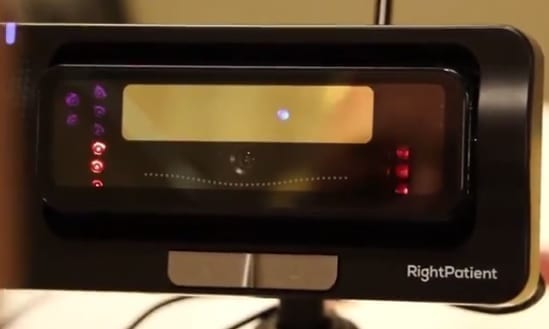
In an effort to better track medical records and avoid mischarting, Fresno's Community Regional Medical Center has instituted a new eyeprint system, in which a camera captures images of a patient's eye as an additional identifier.  At the center, presenting a driver's license or insurance card for proof of identity will soon become obsolete.  Each time a patient registers, a quick snapshot using low-energy infrared light of his or her eye will be taken instead to match up the correct file.  The Fresno hospital system began using the new technology, called RightPatient, three months ago to avoid charting errors and it has been adding biometric devices to its registration desks at its regional medical center downtown, its Fresno Heart & Surgical Hospital and at its hospital in Clovis.  The  technology that was originally used as part of a pilot program is anticipated to be standard at most registrations sites by sometime in June.  Iris recognition is becoming more common at hospitals as they have shift away from paper to electronic medical records.  Hospital executives see the technology as a tool to speed up registration, prevent expensive medical chart mix-ups, reduce charting errors and protect against identity fraud.

Eyeprints Used To Avoid MischartingImage Courtesy of Community Medical Centers

There is never a guarantee that computers will not be hacked and sensitive information shared, and cleanup can be time consuming and costly to remediate.  Not to mention, the patient runs risk of being completely misdiagnosed and treated for the wrong ailments.  And, there have been patients who have died because of chart mix-ups.  Dixon said patients are concerned about biometric identity theft, and rightly so. But, she comments, “You cannot just get another iris.”  Dixon said patients should ask to see a hospital’s notice of privacy practices and review the policy regarding biometric identification. “Don’t get flustered if you do not want to give your biometric to a health-care provider.”  At this time, biometric identification remains optional.  It’s not known how often patient identification errors occur, but researchers at a nonprofit patient safety group, ECRI Institute, examined 7,613 cases of patient charting errors at 181 organizations that occurred between January 2013 and August 2015. The cases were submitted voluntarily. They determined ninety-one percent of the errors were caught before the patient was harmed.  With RightPatient, hopefully they can avoid these errors altogether.  Community Medical Centers spends about $190,000 every year to research and correct mismatched charts.  

Sources:

Checking in? Fresno hospitals first want your ‘eyeprint’ for patient IDMatching the right patient to the right records with ‘eyeprint’ technology

Sara E. Teller

About Sara E. Teller

Sara is a credited freelance writer, editor, contributor, and essayist, as well as a novelist and poet with nearly twenty years of experience. A seasoned publishing professional, she's worked for newspapers, magazines and book publishers in content digitization, editorial, acquisitions and intellectual property. Sara has been an invited speaker at a Careers in Publishing & Authorship event at Michigan State University and a Reading and Writing Instructor at Sylvan Learning Center. She has an MBA degree with a concentration in Marketing and an MA in Clinical Mental Health Counseling, graduating with a 4.2/4.0 GPA. She is also a member of Chi Sigma Iota and a 2020 recipient of the Donald D. Davis scholarship recognizing social responsibility. Sara is certified in children's book writing, HTML coding and social media marketing. Her fifth book, PTSD: Healing from the Inside Out, was released in September 2019 and is available on Amazon. You can find her others books there, too, including Narcissistic Abuse: A Survival Guide, released in December 2017.

Related Articles