Exploring E-scooter Licensing Across Countries
Exploring E-scooter Licensing Across Countries
With their ease of use, cost-effectiveness, and low environmental impact, there's no wonder e-scooters are so popular. In the United States alone, 38 states have legalized their use, and their popularity continues to increase worldwide. It's clear they're here to stay. However, legislation surrounding e-scooters is still evolving. Understanding your local rules and regulations is crucial if you're considering e-scooters as a mode of transport. Here’s everything you need to know about e-scooter licensing, age requirements, and considerations.Understanding e-scooter licensingE-scooter laws are crucial in the expanding micro-mobility landscape. The laws differ significantly from place to place, so you must understand the specific regulations in your locale. One such regulation pertains to licensing, and while many regions across the globe do not necessitate a license to ride an e-scooter, there are exceptions.In the United States, it depends on the state. For example, you need a California and Florida license but not New York, Hawaii, Washington, or New Jersey. Canada's rules vary across provinces. Ontario lets cities decide if they want riders to have a license. In British Columbia, you don't need a license if you're riding in areas taking part in a pilot project.Europe's rules are varied, too. In the United Kingdom, you can only use e-scooters on private land with permission from the owner. Ireland requires a driver's license. However, many countries, like Austria, Denmark, France, Finland, Germany, Italy, Portugal, Spain, and Sweden, don't require a license. Belgium and Poland do require a specific type of driving license.Asia's rules differ significantly, too. Japan requires registration and licensing for scooters faster than 9 km/h. India doesn't require a license, insurance, or registration if the speed is under 25 km/h. Singapore needs riders to have a license and assign a plate number to each scooter. Korea only allows e-scooters on sidewalks between 7 a.m. and 8 p.m.; riders must have a license. Some Southeast Asian countries require a license, while others are less clear.In Australia, the electric scooter rules differ by state and territory. The Australian Capital Territory, Queensland, Tasmania, and Western Australia let you ride an e-scooter in public without a license. South Australia and the Northern Territory only allow e-scooters on private property. New South Wales and Victoria only allow e-scooters in trial locations; no license is needed.Age requirements and e-scootersThe age requirement for e-scooter usage depends on the country or state, with various laws around the globe.In Europe, rules concerning minimum age, maximum power, and compulsory helmet use differ significantly. Some countries have no minimum age for e-scooter riders, while others have specific rules. For instance, children under 8 cannot ride e-scooters in certain regions.In the United States, the most common minimum age for electric scooter riding is 16+, and helmets are usually required for those under 18. However, these rules can differ between states.Many cities have set rules, including a minimum age for the driver, a maximum device speed, and other conditions. This shows that even within a single country, the age requirements can vary based on whether the e-scooter is privately owned or part of a sharing service.The legality of electric scooters, including speed limits and age restrictions, differs worldwide. For example, electric scooters are legal in Singapore but only allowed on shared paths and park connectors.In Australia, the minimum age to ride an e-scooter varies by state. For instance, in Queensland, riders must be at least 12 years old, and those under 16 should be supervised by an adult, according to the Queensland Government's website. In Victoria, e-scooters can only be used in designated areas, and the rider must be at least 18 years old, as per Victoria's Department of Transport.
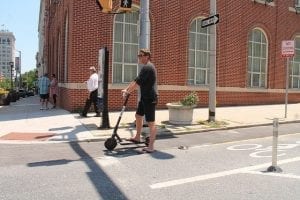 Man riding electric scooter; image by Elvert Barnes, via Flickr, CC BY-SA 2.0, no changes.
About Luke Fitzpatrick
Luke Fitzpatrick has been published in Forbes, Yahoo! News and Influencive. He is also a guest lecturer at the University of Sydney, lecturing in Cross-Cultural Management and the Pre-MBA Program. You can connect with him on LinkedIn.