
Data Analysis: DUI Problems in the United States

Data Analysis: DUI Problems in the United States
Every year, countless lives are impacted by traffic collisions caused by impaired drivers. Driving under the influence (or DUI) can cause lifelong consequences for the impaired driver, other motorists, bikers, and even pedestrians. In 2020, the United States experienced an estimated 38,680 collision-related fatalities, according to data provided by Mothers Against Drunk Driving (MADD). This figure comes out to roughly a 7% increase in motor vehicle deaths compared to the previous year. The primary factors behind this spike in fatalities, despite reduced travel during the early days of the COVID-19 pandemic, were impaired driving, speeding, and failure to wear a seatbelt or age-appropriate restraint. In today’s article, we carefully examine both national DUI statistics and state-by-state laws and regulations prohibiting impaired driving. For our study, we primarily utilize National Highway Traffic Safety Administration (NHTSA) data from 2019, as state-by-state crash data from 2020 onward has not yet been made public. Inspecting Fatal DUI Statistics by StateUsing the NHTSA’s 2019 data, we charted the highest blood alcohol concentration (BAC) of all drivers involved in a unique collision, along with the percentage of each U.S. state’s fatal collisions involving alcohol. As an example, if there were two fatal injuries caused in a single-vehicle crash where the driver’s BAC was 0.17, both deaths would be marked under “# of Fatalities, Highest Driver BAC = 0.15+.”Noteworthy findings:
The three states with the highest percentages of alcohol-influenced collision fatalities were Rhode Island (44%), North Dakota (41%), and New Hampshire (40%)
In two out of every five states, at least 30% of crash fatalities involved alcohol impairment
In some order, Texas, Florida, and California had the highest number of traffic deaths in all three tracked BAC categories
Although technically the District of Columbia is a territory and not a U.S. state, it had the least collision-related fatalities throughout 2019, at 26. The states of Vermont (49) and Rhode Island (71) experienced the next-fewest traffic deaths, even with Rhode Island leading all states in terms of alcohol-involved fatalities
Impaired Motorcycle Accidents, 2019; chart courtesy of author.[/caption]DUI Laws & Regulations by StateAll states (and the District of Columbia) have implemented strict laws designed to cut down on impaired driving and penalize those who endanger their own lives and others on the road. The standards for impairment and required penalties for a DUI vary by state, so we compiled data on each state’s key thresholds. Our chart tracks each state’s:Zero Tolerance BAC Level: Across all 50 states, minors under the age of 21 are held to incredibly strict standards when it comes to alcohol consumption and driving impaired. It is forbidden for minors to purchase or consume alcoholic beverages, which is reflected in “zero tolerance” DUI laws. A zero tolerance law sets the threshold for an underage DUI at a very low level, typically between 0 – 0.02%. Alcohol Per Se Laws: The “per se” limit establishes that, once a driver reaches or exceeds the specified BAC, they are considered legally impaired in the eyes of the law. Currently, all states except Utah have set the per se threshold at 0.08%, while Utah adheres to a lower limit of 0.05%.Enhanced Penalties for High BAC: In some states, committing a DUI at or beyond a specific BAC threshold may result in harsher penalties. This offense is sometimes referred to as an “aggravated DUI.” In states that differentiate between “DUI” and “aggravated DUI” (or the local equivalent), those charged with the latter may face a more serious charge or longer sentence. In our table, the corresponding column indicates 1) whether a state differentiates between high-BAC and regular DUIs and 2) if so, what the corresponding BAC threshold is. [caption id="attachment_4822015" align="aligncenter" width="510"]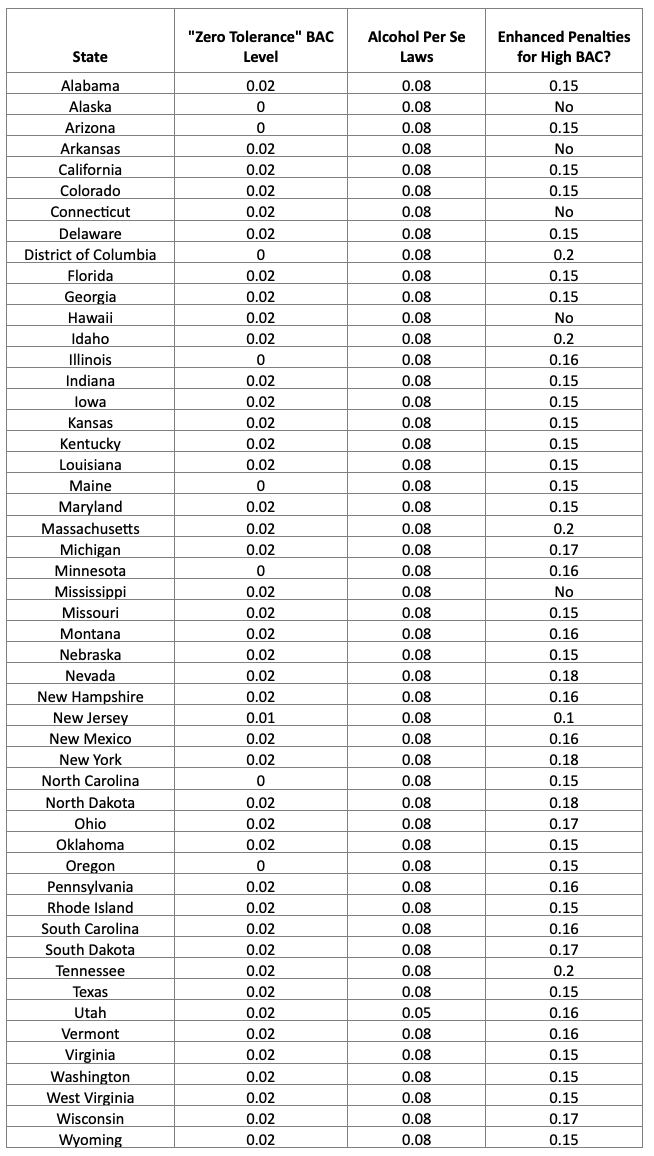 DUI Laws & Regulations by State; chart courtesy of author.

About Jake Sanborn
Jake graduated from the University of San Diego with a bachelor's degree in English and Political Science. When he's not putting together a legal article or analytical piece, you can find him enjoying a nice hike or camping in the Laguna Mountains with friends.