
Carrying Capacity Still Matters Today
Carrying Capacity Still Matters Today
With the war (I mean, “special military operation”) going on in Ukraine tying up two of the world's top wheat producing countries simultaneously, there will be some special challenges this year for people who like to eat food. China and India grow vast amounts of wheat, of course, but most of it is consumed domestically instead of being sold on the world market. Russia, the top wheat exporter, comes in second or third, but they're busy sending able-bodied potential farmworkers to invade number 9, Ukraine. With those two producing much less than they ordinarily would, the world is going to get a crash course this year in why carrying capacity still matters.Carrying capacity, in this context, is how many human beings a given landbase can support indefinitely. It meant a lot, back when we were mainly hunters and foragers. If a flood, fire, or drought ruined the landscape, it wouldn't be possible to import all the food people needed from far-flung places around the globe. It may seem like the tag team advances of agriculture, science and trade have canceled the idea that the carrying capacity of any particular country would matter anymore; after all, the conventional wisdom behind free trade is that we can all do better by making more of what we're good at and trading it for everybody else's surplus. However, that only works up to a point, and then it's a disaster.Take the United Kingdom, for example. They've been importing food for ages, as their population surpassed what could be fed by domestic production. These days, they're importing about 45% of their food supply, mostly from EU countries. After Brexit threw a spanner into the customs processing works, one of the first disasters they faced was a food shortage. Trucks waited at the border, ships waited in port, and even a couple days of sitting around takes a toll on cargoes of fresh food.Diversifying the food supply through imports can lend resilience to the system if local conditions fail, but depending upon imports to feed everyone means hoping really hard that supply chains remain stable and that trading partners are able to supply everything you need when you need it, forever. As we've seen them buckle and break during the pandemic of late, it's easy to understand why being able to produce everything you need locally is a real life saver. Exceeding the carrying capacity of the local landbase is risky, potentially dangerous.Which brings us back to Russia and Ukraine. Middle Eastern countries are major buyers of Russian and Ukrainian wheat, and supplies were already tight heading into the invasion. People are hungry there already. The United States withdrawal in Afghanistan and subsequent change in leadership plunged Afghans into the kind of famine that they're selling their organs and their children to survive. Seven years of war in Yemen means their people are starving, too. Unaffordable food prices were one cause of the Arab Spring protests and revolutions in 2011. Back then, it was simply uneven food distribution, but if Russia and Ukraine can't contribute as much of their harvests to the world's food system, the difference in causes is less important than the real world results.
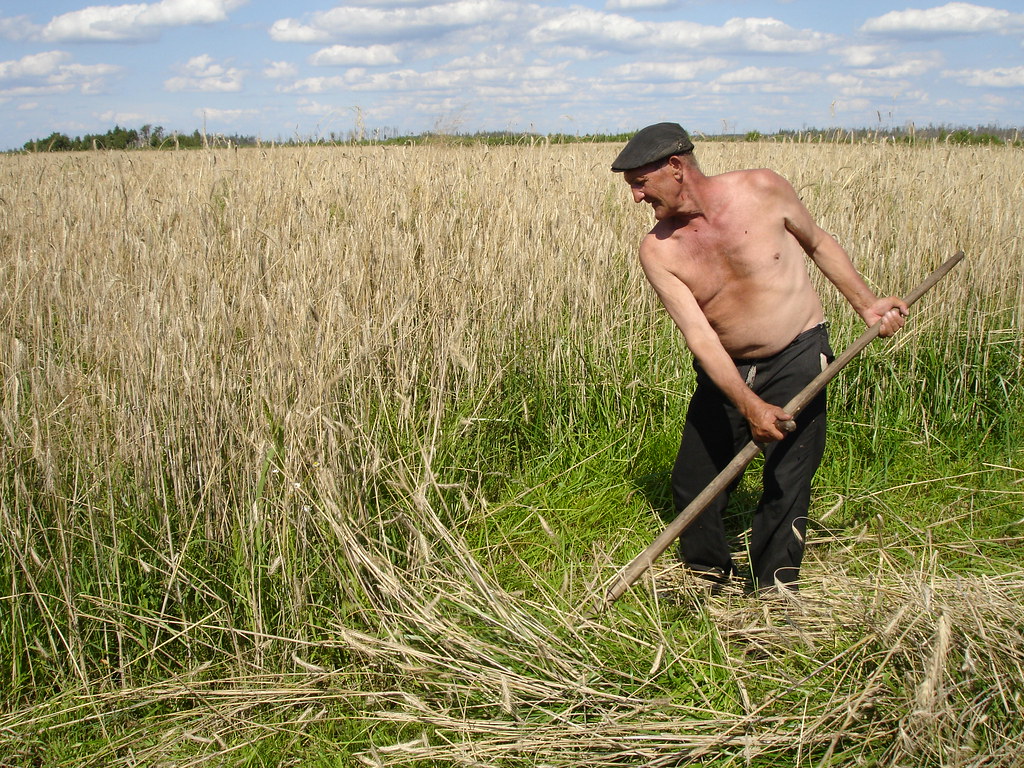 A farmer in Jelno, a village about 300 km away from Chernobyl, is able to work the land again after remediation measures (in 2005). Photo by Petr Pavlicek/IAEA, via Flickr. CC BY-SA 2.0
Sources:
TOP 10 Wheat Producing Countries in 2020/21
Food Statistics in your pocket: Global and UK supply
The British government's first disaster of 2021? A food shortage
Sharon Astyk on Facebook
Afghanistan: Parents sell children and kidneys to feed starving families
Millions in Yemen ‘a step away from starvation’
Food Price Spikes and Social Unrest: The Dark Side of the Fed’s Crisis-Fighting
Ukraine war: Farmers resolve to get spring crops planted
OSINTtechnical on Twitter
How Joseph Stalin Starved Millions in the Ukrainian Famine
The Commodification of Wildness and its Consequences
Germans allow over one million hectares of greening land to enter production
Russia's war on Ukraine is dire for world hunger. But there are solutions
Surging gasoline prices bring back memories of past energy wars
The Nation’s Corn Belt Has Lost a Third of Its Topsoil
More Fertilizer Volatility?
As fertilizer prices spike, Philippines looks to China, Iran for supplies and discount
Russia Bans Fertilizer Exports; Will Weigh on Brazil Corn Crop
Carrying Capacity and Overshoot: Another Look
Catton, William R. Overshoot: The Ecological Basis of Revolutionary Change. Urbana: U of Illinois, 1982. Print.
About Dawn Allen
Dawn Allen is a freelance writer and editor who is passionate about sustainability, political economy, gardening, traditional craftwork, and simple living. She and her husband are currently renovating a rural homestead in southeastern Michigan.